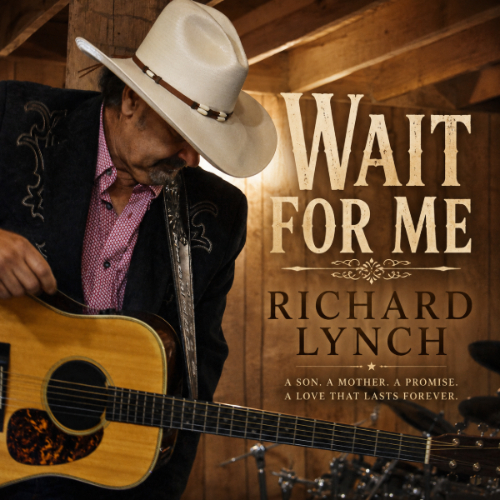
Richard Lynch has spent years planting his boots firmly in traditional country soil while much of Nashville has wandered elsewhere, and “Wait For Me” makes a convincing case that he picked the right field. This isn’t revisionism or retro cosplay. It’s an old-fashioned country weeper that remembers why people cried in the first place.
The premise is straightforward: a son rushes to his dying mother’s bedside, hoping she’ll hold on long enough for one final goodbye. That setup could have collapsed under the weight of sentimentality. Instead, Lynch and co-writer John Lee sidestep melodrama by concentrating on specifics. The song’s recurring image of a mother’s hands—hands that stitched clothes, comforted children, eased pain, and quietly built a family—grounds the lyric in lived experience rather than Hallmark abstraction.
Lynch’s vocal helps. He doesn’t possess the kind of voice that dominates talent shows, nor does he seem interested in chasing vocal fireworks. His weathered baritone communicates conviction over virtuosity. Every line feels spoken as much as sung, which suits material built on memory rather than spectacle.
Production follows the same philosophy. Acoustic guitar, restrained steel, and gentle accompaniment stay where they belong—in service to the story. The arrangement never reaches for cinematic crescendos because it doesn’t need them. Like the best traditional country records, it trusts that a strong lyric delivered honestly carries its own momentum.
Faith runs through the song naturally. References to God and eternal peace don’t function as commercial signposts aimed at a particular audience; they’re part of the family’s worldview. That matters because the song isn’t ultimately about death. It’s about gratitude. The narrator isn’t bargaining with heaven. He’s simply asking for one more chance to say what should never go unsaid.
Country music has a habit of rediscovering its strengths whenever it remembers ordinary people are more interesting than manufactured myths. Lynch understands that. His mother isn’t idealized into sainthood; she’s honored through the ordinary work of motherhood. That’s considerably more persuasive than grand declarations ever could be.
If there’s a critique, it’s that “Wait For Me” rarely surprises musically. Listeners hoping for structural innovation or adventurous production won’t find it here. Lynch knows exactly the kind of record he’s making and never wanders outside those lines. Whether that’s limitation or discipline depends entirely on what you ask country music to accomplish.
Fortunately, emotional credibility ages better than fashionable production. The song’s greatest achievement is that it feels earned. Rather than insisting listeners cry, it gives them room to remember someone they’ve loved. That’s a subtle but important distinction.
In an era when too many country songs confuse volume for emotional depth, “Wait For Me” quietly insists that restraint still has power. Richard Lynch isn’t reinventing traditional country—he’s reminding listeners why it became tradition in the first place.
–Bobby Chrisman