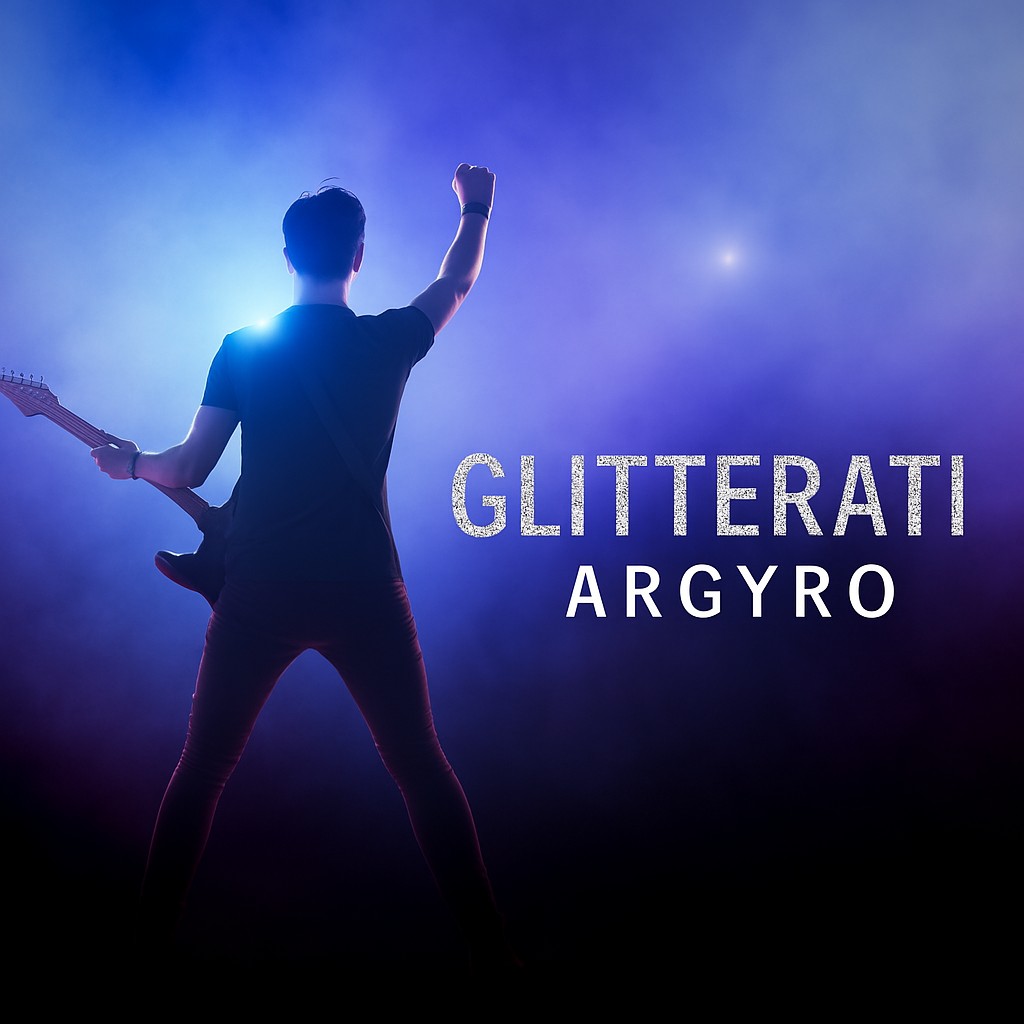
There’s a moment, somewhere between the neon blur of a late-night drive and the flicker of an old movie you’ve seen too many times, where ARGYRO’s Glitterati really begins to make sense. It’s not just an album—it’s a mood, a mirrorball spinning over a half-empty room, catching fragments of memory, ego, romance, and longing all at once.
Scott Argiro doesn’t just write songs here—he casts scenes. You can feel it from the opening title track, where the narrator tosses his shades “at the paparazzi” and embraces his role as a “part-time movie star” . It’s playful, sure, but there’s something deeper under the shimmer—like a guy half-aware that the spotlight he’s chasing might be made of smoke and projection. I would frame this as the kid backstage, watching the lights, wondering if they’ll ever feel like home.
That tension—between fantasy and reality—runs through the entire record.
“Cool Shades” drifts in like a coastal daydream, all salt air and soft-focus desire. It’s escapism done right, not forced but earned, like a Polaroid left out in the sun. You can almost hear the waves folding into the melody. And then there’s “She’s So LA,” which plays like a love letter to both a woman and a city—fast, dangerous, intoxicating. The imagery of the 405 and Santa Ana winds doesn’t just set the scene—it is the scene. You’re there, chasing something you’re not sure you’ll ever catch.
But Glitterati isn’t just about the chase—it’s about what happens when the music fades and you’re left alone with the echo.
“The Phenomenon” struts with swagger, full of self-mythology and electric confidence, yet even in its bravado there’s a sense that the persona might be armor. It’s the rock star talking to the mirror, hyping himself up before stepping out into the noise. And then, almost as a counterpoint, you get something like “House Upon the Mountainside,” which feels like pulling off the road entirely—quiet, reflective, steeped in memory. It’s where the album exhales.
Argiro’s writing shines brightest in these contrasts. He understands that glamour without vulnerability is just surface. Songs like “So One of a Kind” and “Perfect Endings” lean into that truth—romantic, yes, but tinged with the knowledge that nothing lasts quite the way we want it to. The line between cinematic love and real-life impermanence blurs beautifully.
And then there’s “Lifeline,” which might be the emotional core of the whole thing. It reaches outward, beyond ego, beyond illusion—toward connection. The idea that “we’re all just the same… flowing to the same place” lands like a quiet revelation after all the flashing lights. It’s the moment in the movie where the music drops out and the character finally says what they mean.
What makes Glitterati resonate is that it never fully resolves its contradictions. It lives in them. It’s about wanting the spotlight and questioning it at the same time. It’s about love that feels cinematic but slips through your fingers like real life always does.
And maybe that’s the point.
Because in the end, Glitterati isn’t about being a star—it’s about what it feels like to almost be one, to believe in the illusion just long enough to make it real.
–Cam Crowning