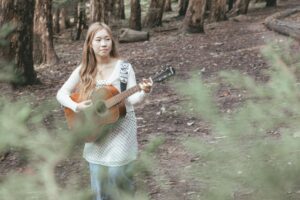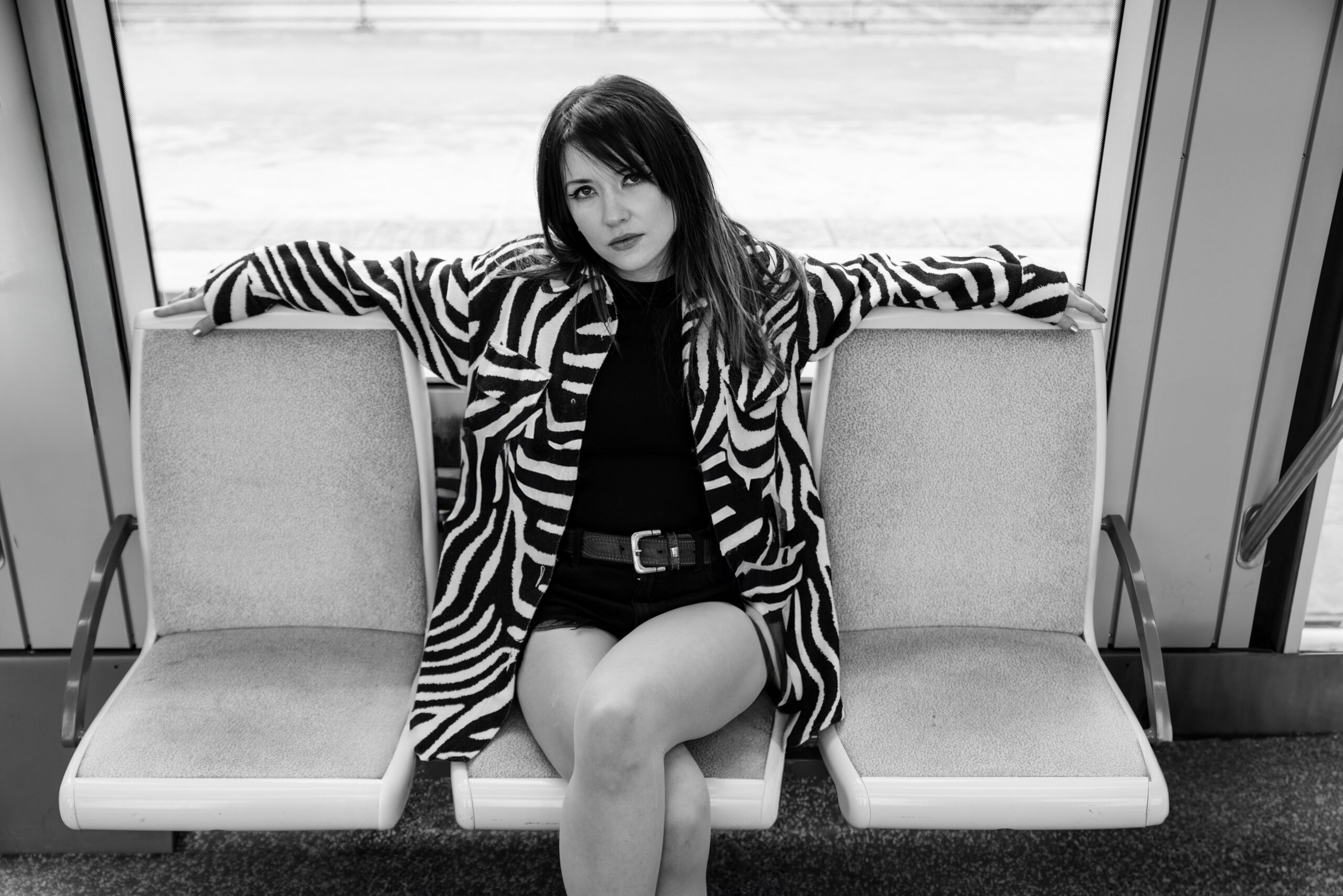
Photo by Marion Fort
The EP’s called Ganbaru, which is all about pushing through even when things are tough. How has that idea played out for you since going solo?
Going solo really put me face to face with that idea in a very concrete way. Ganbaru isn’t just a concept for me — it became a daily mindset. When you’re on your own, there’s no one to hide behind, no immediate reassurance, so you have to keep going even when doubt creeps in. This EP was born from that tension: learning to trust myself, to push through uncertainty, and to keep creating even when things feel fragile. In a way, it’s been both a challenge and a quiet form of empowerment.
You worked with Scenius on the Lonely Sun remix. How did their style shape the vibe of the EP?
I really loved this collaboration. Scenius brought a more hypnotic and emotionally immersive dimension to Lonely Sun. Their approach opened up the track, giving it a wider, almost suspended kind of space.
Even though it’s a remix, it still resonates deeply with the core of the EP — that sense of introspection and subtle tension — but through a more electronic and atmospheric lens. It feels like an extension of the project rather than a reinterpretation.
You’ve said this EP is more intimate. What was it like writing songs in that way compared to your earlier music?
I’ve always worked in a duo before, and for a long time I found that very reassuring. Co-writing gives you immediate feedback, another perspective, a sense of validation. I was used to that constant exchange.
With Ganbaru, I had to learn how to sit alone with my ideas, in my own space, and trust my instincts. Most of the process happened remotely with my co-writer and producer, and we only met in person at the very end to finalize things and record vocals. At first, it felt a bit disorienting, even slightly isolating.
But over time, facing that silence — and my own doubts — became something quite powerful. Without immediate feedback, I had to go deeper, be more honest. It turned into a very freeing experience, and ultimately a much more personal way of writing.
Themes like isolation and self-acceptance run through the EP. Is there a track that really hits home for you personally?
Definitely “I Might Be Weird.” It’s probably the most personal track on the EP. It really reflects my identity and where I come from. I was born in Poland, but I chose to build my life in France.
Definitely “I Might Be Weird.” It’s probably the most personal track on the EP. It really reflects my identity and where I come from. I was born in Poland, but I chose to build my life in France.
Even though I feel deeply connected to both cultures, I sometimes feel slightly out of place in each of them. It can be in small, everyday things — habits, tastes, ways of reacting or thinking. And that in-between space can be confusing, sometimes even frustrating.
This song is about embracing that duality. Accepting that maybe I don’t fully belong in one place or another — and that it’s okay. It’s part of a longer journey of understanding who I am and learning to feel at peace with that.
Low & Slow feels like a celebration of creative freedom. What does being “free” creatively mean to you right now?
Right now, creative freedom means letting go of outcomes. Not thinking about numbers, algorithms, streams, or expectations. Just allowing myself to dive into the process without constantly questioning its value.
Right now, creative freedom means letting go of outcomes. Not thinking about numbers, algorithms, streams, or expectations. Just allowing myself to dive into the process without constantly questioning its value.
It’s about experimenting more, stepping away from formulas, and forgetting — at least for a moment — what’s supposed to “work” in the industry. I’m trying to reconnect with the very first reason I started making music: the pure pleasure of creating. That’s where I feel the most honest, and ultimately the most free.
What drew you to Black Balloon (originally by The Kills), and how did you make it your own?
I’ve always been a huge fan of The Kills, and Alison Mosshart has been a major inspiration for me for years. Black Balloon is a song that stayed with me long before I fully understood its meaning — it touched me instinctively, both musically and visually.
I’ve always been a huge fan of The Kills, and Alison Mosshart has been a major inspiration for me for years. Black Balloon is a song that stayed with me long before I fully understood its meaning — it touched me instinctively, both musically and visually.
Choosing to cover a song by The Kills felt risky because it’s so personal to me. But at the same time, it made sense. The emotional weight of the song and its themes aligned perfectly with the closing of Ganbaru.
We approached it with a slightly more industrial and textured sound, introducing colder electronic elements and more vocal effects, while still preserving the organic essence of the original. It became less about reinterpreting the song and more about extending its emotion — creating a sense of continuity with the rest of the EP.
You’ve mentioned cutting back on reverb and guitars to focus on your voice. How has that changed the way you perform live?
For a long time, I was hiding behind layers — effects, guitars, textures. With this project, I wanted to strip everything back and start from something more honest, more exposed.
For a long time, I was hiding behind layers — effects, guitars, textures. With this project, I wanted to strip everything back and start from something more honest, more exposed.
Letting go of the guitar on stage and reducing the effects pushed me to really inhabit my voice and my body differently. I feel closer to the audience, more present, more direct. It’s also more vulnerable — there’s nowhere to hide — but that’s exactly what I was looking for.
I’m still discovering what that means in practice, and I’m definitely still figuring things out on stage (laughs), but with every performance it feels more natural. It’s a kind of rebirth — learning how to be “naked” again in a very conscious way.
After touring a ton with The Blind Suns, how does performing solo feel different for you?
What really changed for me isn’t so much the moment on stage, but everything that happens before it. With The Blind Suns, there was a shared responsibility — decisions, direction, organisation. Now, as a solo artist, I carry that responsibility myself.
What really changed for me isn’t so much the moment on stage, but everything that happens before it. With The Blind Suns, there was a shared responsibility — decisions, direction, organisation. Now, as a solo artist, I carry that responsibility myself.
On stage, I’m still surrounded by musicians — we’re still three performing live — so in that sense, the energy and the connection remain very similar, and I feel supported by a strong and reliable team.
The real shift is in the overall vision and decision-making. I’m now the one guiding the project, making the final calls, shaping its direction. It’s a different kind of pressure, but also a very empowering one.
You’ve been part of the Keychange programme supporting women in music. What changes do you hope to see in the industry?
Keychange was a really important experience for me. It highlighted both the progress that’s been made and how much still needs to evolve.
Keychange was a really important experience for me. It highlighted both the progress that’s been made and how much still needs to evolve.
I’d love to see a more balanced and inclusive industry — not just in terms of visibility on stage, but also behind the scenes: producers, sound engineers, decision-makers. Representation matters at every level.
More than anything, I hope for a space where diversity isn’t something exceptional, but simply the norm. Where artists can exist and create without having to justify their place.
Looking ahead, where do you see Ganbaru taking you creatively? Any new directions you’re excited to explore?
Ganbaru feels like a starting point more than a destination. It opened a door to a more honest and intuitive way of creating, and I want to keep exploring that.
Ganbaru feels like a starting point more than a destination. It opened a door to a more honest and intuitive way of creating, and I want to keep exploring that.
I’m really interested in pushing that intimacy further, but also in experimenting with new textures — maybe blending organic and electronic elements in unexpected ways.
Most importantly, I want to keep following what feels right rather than what feels safe. If Ganbaru taught me anything, it’s that stepping into the unknown is where the most meaningful things happen.