By Marissa Cole
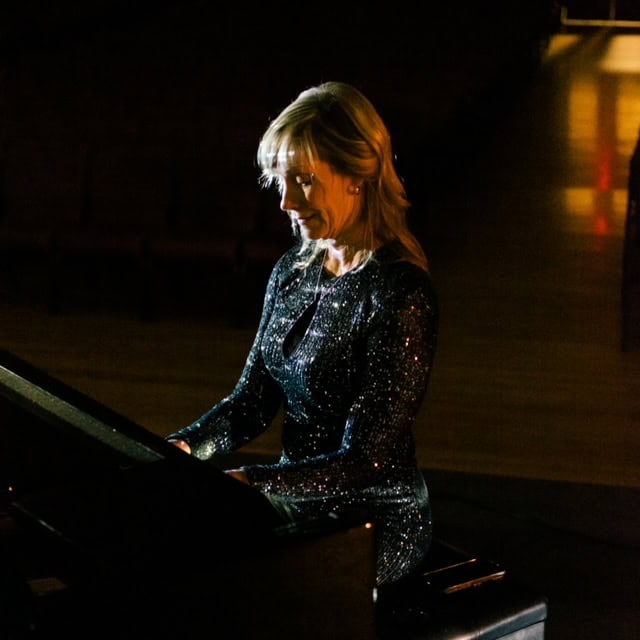
Memory rarely behaves like a complete story. More often, it appears as a sensory interruption: the smell of sunscreen, the sound of children laughing, a familiar chair around a family table, or the lingering impression of a parent’s hand. On “Glimpses,” Canadian composer and pianist Bonnie Milne turns those fragments into an instrumental work that understands nostalgia as both comfort and disruption.
The composition begins with deliberate restraint. Milne’s piano establishes a reflective atmosphere, allowing individual notes to settle before the arrangement begins expanding around them. This spaciousness suggests someone approaching a memory carefully, aware that getting too close might alter its emotional meaning. The melody is tender, but it avoids easy sentimentality. Its calm surface contains an undercurrent of absence.
That complexity is expressed through Milne’s movement between major and minor chords. The major passages possess a warm, almost domestic glow, while each transition into minor introduces the realization that the remembered moment cannot be fully recovered. Rather than treating joy and sadness as opposites, Milne allows them to coexist. The happiness within “Glimpses” becomes more valuable because it is temporary; its sorrow exists because something beautiful happened in the first place.
Cellist Kevin Fox deepens that emotional ambiguity. His playing has a human quality, with countermelodies that seem to respond to Milne’s piano rather than merely accompany it. GRAMMY and JUNO Award-winning violinist Drew Jurecka adds a brighter voice, delivering melodic lines that feel playful, luminous and faintly restless. The two string performances pull in complementary directions—one looking inward, the other reaching ahead.
Percussionist Dave Hewitt gives the piece its sense of time. His timpani-like drum line begins as a restrained pulse, adding warmth without disturbing the opening’s intimacy. When “Glimpses” moves into its faster allegro section, Hewitt becomes the force carrying the composition forward. The transition does not erase the earlier longing; it converts it into momentum.
This shift is the piece’s defining decision. Many compositions about memory remain suspended in reverence for the past. Milne is more interested in what remembering makes possible. The second section suggests acceptance—not the clean closure promised by inspirational slogans, but the quieter understanding that new experiences do not betray the old ones.
Recorded at Villa Sound in Collingwood, Ontario, with owner and engineer Adam Fair, “Glimpses” maintains clarity across its changing emotional landscape. The piano remains central, while the cello, violin and percussion retain distinct personalities. Fair’s production gives the instruments room to breathe without allowing the arrangement to feel disconnected.
Milne’s catalog has earned more than 200,000 Spotify streams, while “New Beginnings” reached the radio Top 20 and “Perception” topped the UK iTunes chart. “Glimpses” feels less concerned with milestones than with the ordinary experiences that quietly become irreplaceable.
It does not attempt to preserve the past intact. Instead, Milne shows how memory changes shape as life continues—and how its light can illuminate the road ahead.